
Table of Contents
Transitional Arrangements
In the development and implementation of the National Addressing System (NAS) in Oman, transitional arrangements must be undertaken to create and maintain NAS data effectively. Both scenarios, where no existing system is present and where an existing system is in place, need specific approaches to ensure a smooth transition.
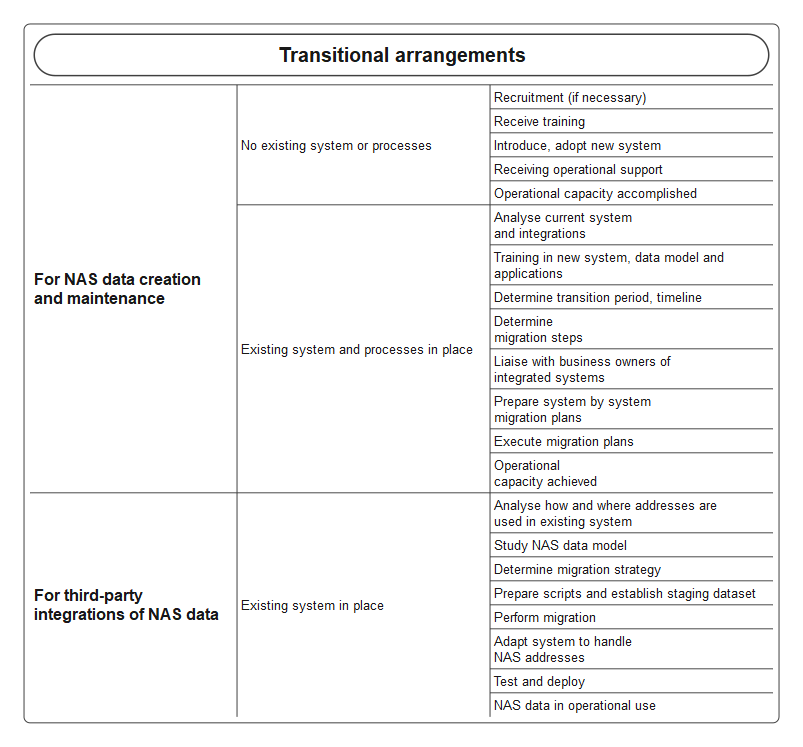
1. For NAS data creation and maintenance
1.1 No existing system or processes in place
Where no systems or processes currently exist, a foundational approach is required. Initially, recruitment might be necessary to bring personnel on board who will engage with the NAS. Staff members involved in the system will require comprehensive training to become acquainted with the new processes and technologies. Once trained, the introduction and adoption of the new system can proceed. During this phase, it is crucial to have operational support available to assist users. As the personnel become proficient, the operational capacity to manage the NAS independently will be achieved.
1.2 Existing system and processes in place
For organisations with pre-existing systems, a more nuanced strategy is needed. First, an analysis of the current system and its integrations should be conducted to understand the current workflow. Subsequently, there must be training in the new system, data model, and relevant applications to ensure a seamless transition. The transition period and timeline should be clearly defined, detailing each step of the migration process. It is essential to liaise with the business owners of integrated systems to facilitate cooperation and understanding. Preparing detailed migration plans for each system is a critical step before executing these plans. Once the process is complete, the operational capacity for addressing tasks under the NAS will be attained.
2. For third-party integrations of NAS data
Where existing systems already utilise addresses, the integration of NAS data necessitates several steps. Initially, it is crucial to analyse the current use of addresses within these systems. Understanding the NAS data model is essential for effective integration planning. Developing a clear migration strategy will guide the transition process. Scripts should be prepared, and a staging dataset established for trial runs. The migration itself can then be performed, followed by necessary adaptations enabling the system to handle NAS-formatted addresses. After these modifications are completed, testing ensures that changes function correctly before deployment. Once NAS data is operational within the system, it can be used effectively for all addressing needs.
3. IT systems affected by changes, updates to addresses
For existing systems where addresses are already in use, it is necessary to execute a data migration plan consisting of the following steps:
- Analyse current addresses
- Analyse new model
- Determine how old addresses can be auto updated to new addresses by means of geocoding/matching
- Prepare scripts to conduct upgrade
- Prepare a staging environment with complete copies of data
- Test scripts
- Analyse results, error margins
- Establish processes for manual correction
- Roll out to production data with a transition period of at least 1 year when both addresses will be available in the system (not necessarily in the user interface but by necessity in the database)
- Addresses are now operational in the new system
- If legal documents are printed/issued that include addresses, make a plan for reissuing these documents with new addresses according to the normal renewal cycle for the specific documents, i.e. annual leases, contracts etc.
4. Training
MoHUP must employ personnel who can provide training for new users. This is assumed to be a part time function in the operational stage but may be scaled up during the initial stages when addressing process capacity is being built up across the country.
5. Operational support
MoHUP must employ personnel who can provide day-to-day operational support in standard, GIS-data, application and signage/engineering related matters. This is assumed to be a part-time function in the operational stage but may be scaled up during massive implementation throughout the country.